
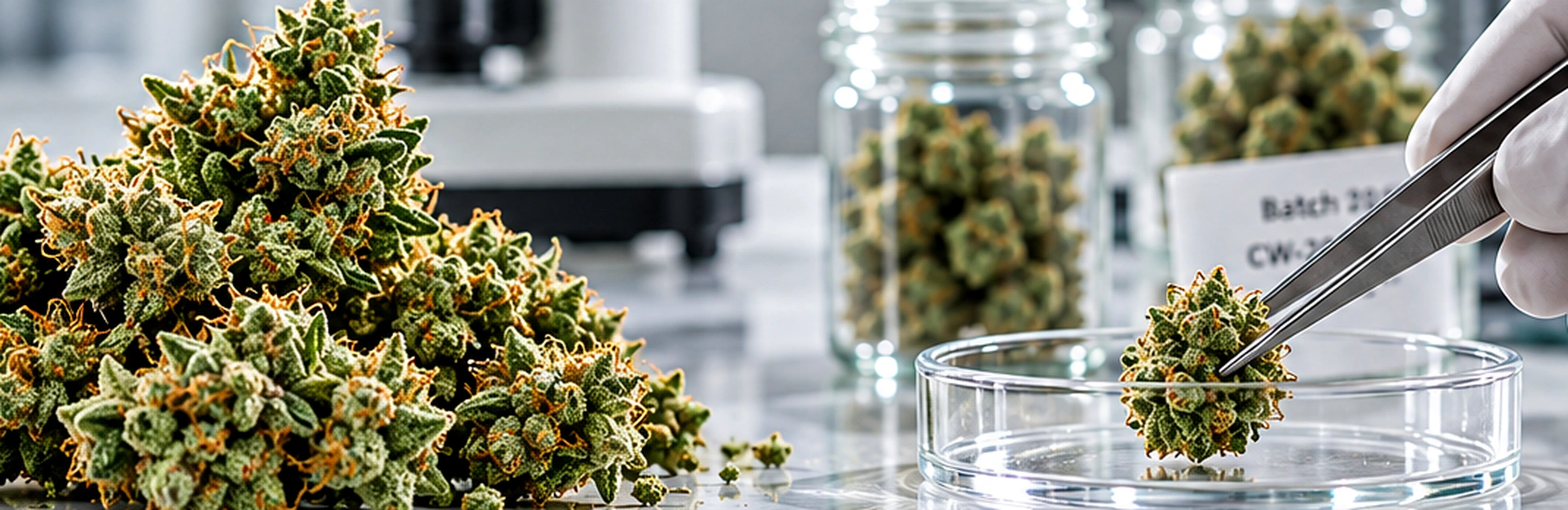
High CBD content, attractive flowers and a low price per kilogram do not make a purchase reliable on their own. In commercial CBD flower wholesale every informed product assessment should consider whether product data, laboratory report and the actual delivered batch match.
This guide explains step by step how buyers can read a test report, which details matter and what to ask before ordering. It concerns quality management, not blanket permission to sell.
1. What is a COA or batch record?
A Certificate of Analysis (COA) is a document containing measurements for a particular tested sample. Depending on the laboratory and testing brief, it may show cannabinoid levels, contaminants or other characteristics. A batch record links relevant information to an identifiable consignment. The market does not always use these terms consistently.
Buyers should therefore not rely on a document's heading alone. A report showing THC and CBD levels helps assess a delivery only if the sample and batch it relates to are clearly identified.
2. Check that the laboratory report matches the goods
Start with identifying information. Do product name, strain, batch number and sample description match? Who took the sample – the supplier or an independent organisation? When was it tested and how long have the goods been stored since? A recent document alone does not prove representative sampling.
- Batch: A clear number or identifier must appear on the goods, delivery note and document.
- Laboratory and report: The name, full report reference, date and, where applicable, responsible testing staff should be identifiable.
- Sample description: Was the tested material actually in the product form offered – for example, dried flowers?
- Testing scope: Were only cannabinoids tested, or also residues, microbiological parameters and moisture?
The offer says “Flowers – batch CW-1026”, but the report only says “Hemp sample 2025”. Without a traceable link, the report should not be treated as sufficient evidence for this delivery. Ask: “Can you clearly link this analysis to the batch you are offering us?”
3. Understanding CBD content, CBDA and marketing claims
CBD stands for cannabidiol. Some cannabinoids occur in the plant as acidic precursors – for CBD, this is CBDA. Some reports list individual measurements and a calculated total. “CBD 15%” and “total CBD 15%” are therefore not necessarily identical.
Check whether a figure in the offer means directly measured CBD or total CBD calculated using the relevant method. If there are differences, retailers should request a consistent specification. In particular, a single unspecified percentage range should not be applied uncritically to every delivery across multiple strains.
4. THC, THCA and the 0.3% question
Δ9-THC and its acidic precursor THCA must be distinguished analytically. Depending on the method, acidic forms may be reported separately or partly included during analysis. A complete report should explain what is actually measured and how any total was calculated.
In September 2026, Germany's Federal Institute for Risk Assessment reported on an interlaboratory cannabinoid analysis study involving 19 laboratories. The results highlight the importance of measurement methods and comparability when interpreting results. Buyers should therefore consider methods, units and, where relevant, measurement uncertainty rather than just one number.
Important for the German market: A THC value below 0.3% is not universal legal clearance for manufacturing, possessing, distributing or selling CBD flowers to consumers. The current industrial hemp definition in the KCanG, the specific distribution channel and other rules must be assessed separately. A laboratory certificate does not replace a legal product assessment.
5. How can you assess a testing laboratory?
Accreditation to DIN EN ISO/IEC 17025 can be helpful. The German Accreditation Body (DAkkS) explains that this standard sets requirements for competence, impartiality and consistent laboratory operations. Look beyond the logo and check the specific scope of accreditation: not every test a laboratory offers is automatically covered by its accreditation.
For particularly important batches, it may be useful to have your own representative sample tested by a suitable laboratory. This costs money but can reduce uncertainty about specifications, identification and methodology.
6. What else may matter besides cannabinoids?
A cannabinoid profile alone does not assess every quality or safety aspect. Depending on product category, intended use and risk assessment, additional factors may include:
- Pesticide and crop-protection residues: Especially relevant when the cultivation and supply chain are unclear.
- Heavy metals: Origin and growing conditions may be relevant to assessment.
- Microbiology and mould: Important when considering storage, drying and possible moisture.
- Water content and water activity: These values may help assess storage stability and mould risk.
- Foreign material: Visual inspection, clean processing and traceable complaint procedures complement laboratory figures.
There is no single list of legally mandatory tests for every CBD and hemp product. B2B buyers should establish a suitable testing and release process for each product group.
7. Five common purchasing mistakes
- Accepting a signature or laboratory logo without checking: Verify that the report exists and is valid.
- Using an old report for a new batch: One tested sample does not automatically substantiate every subsequent delivery.
- Comparing “CBD content” without a definition: Distinguish CBD, CBDA and total CBD clearly.
- Equating 0.3% with general legality: Consider product and cannabis law independently of the analysis document.
- Considering price alone: Factor in documentation, supply stability, storage and responsibilities.
Checklist for your next CBD B2B enquiry
Send these questions to prospective suppliers:
- What is the exact batch number of the goods offered?
- Is the analysis report clearly linked to this batch?
- Which cannabinoids were measured and how are totals defined?
- Which analytical and sampling methods were used?
- Is the laboratory accredited for the relevant procedures?
- Which additional tests were performed?
- How are storage, traceability and complaints handled?
- What product category and intended use are specified, and who assessed eligibility for sale?
8. Conclusion: a laboratory report is one part of the assessment
Commercial CBD flower buyers need traceable information on origin, batch, cannabinoid levels and other quality-related characteristics. A good COA can help establish whether goods meet agreed specifications. It does not remove the need for supplier assessment or legal classification of the product.
We also provide a guide to choosing reliable B2B suppliers and an overview of the 2026 debate on the industrial hemp misuse clause.
Frequently asked questions
What does COA mean for CBD flowers?
COA stands for Certificate of Analysis. It records test results for a sample. Scope, methods and a clear link to the goods offered are crucial.
Does a batch record authorise the sale of CBD flowers?
No. It supports traceability and quality assessment, but does not replace legal assessment of the goods and their intended distribution.
What is the difference between CBD and total CBD?
Total CBD may include CBD and a calculated contribution from its acidic precursor CBDA. The test report must state the definition used.
What matters in a THC laboratory report?
Traceable sample identification, the measured quantities Δ9-THC and, where applicable, THCA, units, test method and any measurement uncertainty – alongside a separate legal assessment.
Are laboratory tests for pesticides and mould always mandatory?
That depends on product category, intended use and applicable requirements. A cannabinoid profile does not automatically test these parameters.
Sources and further information
BfR – interlaboratory cannabinoid study, September 2026 ↗
Consumer Cannabis Act – current wording ↗
European Commission – Novel Food Status Catalogue ↗
Editorial information, updated 28 October 2026. Not legal advice or a statement on the eligibility for sale of individual products. Current legislation and product-specific requirements must be checked before business decisions.
Read more: Misuse clause 2026 – current situation or How to compare B2B suppliers.
Informed guidance for CBD wholesale.
The insights section of cbdgrosshandel.de provides practical guidance, market information and further resources for trade buyers.
View all articles ↗